SP-I in $20M Award from National Academies of Sciences, Engineering, and Medicine (NASEM) ||
PhD Student Waleed Khan reaches graduation ||
SP-I against a major Gulf Challenge ||
SP-I in $20M Award from National Academies of Sciences, Engineering, and Medicine (NASEM) || PhD Student Waleed Khan reaches graduation || SP-I against a major Gulf Challenge ||

Welcome to the Structural Performance & Fluid-Structure Interaction (SP-I) LAB!
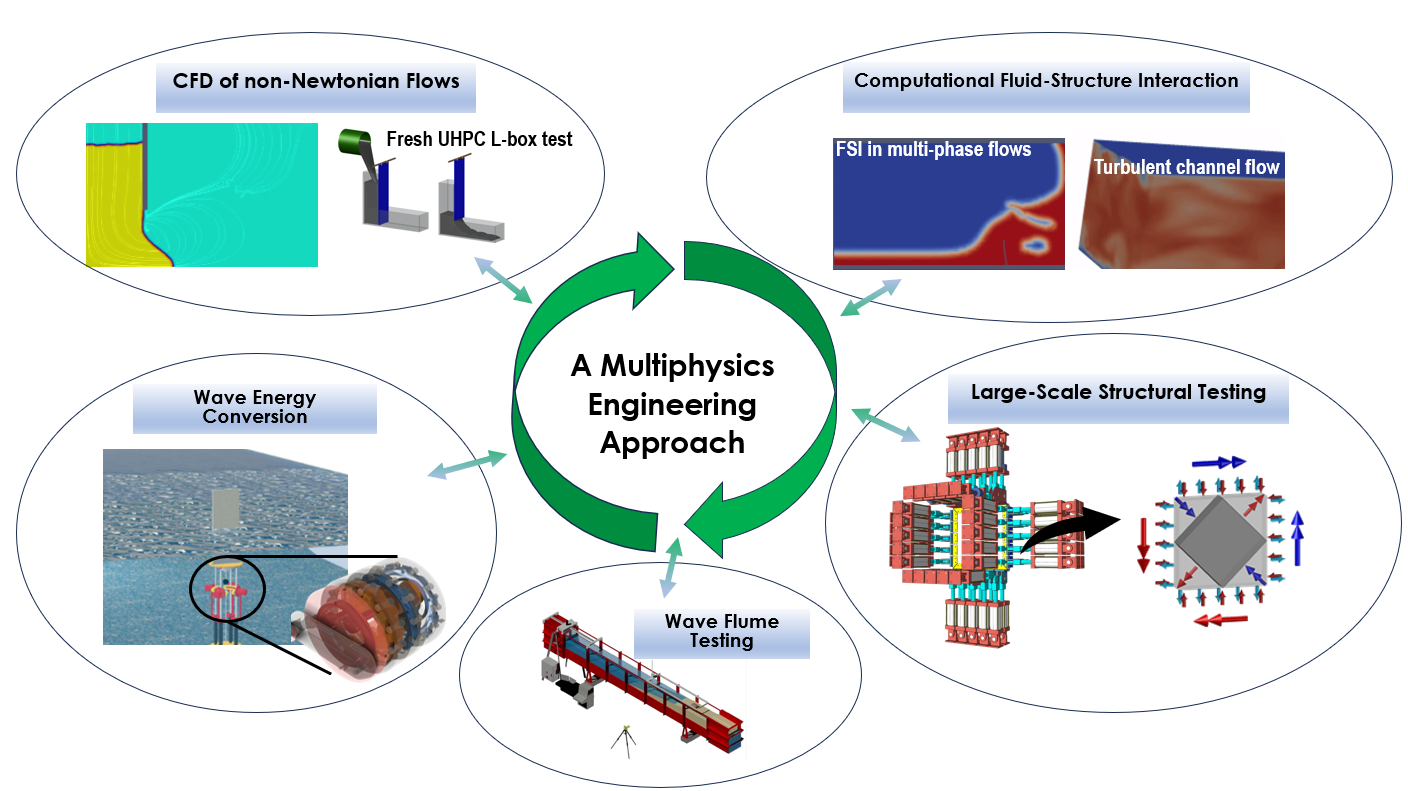
In SP-I Lab, we leverage multiphysics principles to resolve fundamental engineering problems spanning structural engineering and fluid mechanics. Our research goal is to develop and investigate innovative structural and energy systems through multi-scale experimentation and computational methods for onshore and offshore applications.
Our planet has a finite number of resources and a growing population that overloads our aging infrastructure and energy resources. These factors create the need for advanced long-lasting technologies, onshore and offshore, that deliver superior strengths, harvest energy, and minimize repair-replacement cycles. Addressing these contemporary challenges necessitates an integrated, multidisciplinary strategy. New structural systems in onshore and offshore environments are exposed to extreme loads driven by natural hazards and other processes, which require a thorough understanding of fluid-structure interaction (FSI) phenomena and necessitate integrity and reliability in performance.
Fluid-structure interaction effects are omnipresent in engineering. The constitutive behavior of structural concrete technologies, such as UHPC (among other fiber-reinforced materials), is dictated by the fiber-matrix interactions during casting, which influence fiber alignment. Onshore and offshore structures and ecosystems interact with wind and wave flows, storm surge and flooding. Marine energy systems harvest the natural energy from moving water to produce power. By integrating principles of fluid and structural mechanics, SP-I’s multiphysics vision is to bridge knowledge gaps and deliver comprehensive, mechanics-based solutions.
A pivotal outcome of our research is the training of a new generation of engineers uniquely equipped to re-conceptualize engineering problems by integrating multiphysics effects across fluid and solid phase states.
Undergraduate and graduate students in our research group are exposed to both structural laboratory testing, computational modeling of the experiments, and fluid-structure interaction problems. Visit our current and past graduate students and undergraduate assistants. Active research themes can be found here. Prospective PhD students are encouraged to review the Student Positions page.


SP-I initiated a campaign for the adoption of high-strength steel bars (HSRBs) by the masonry industry in the United States.
This video presents a direct tension test of a Grade 80 bar lap-splice used to investigate the bond of HSRBs in structural masonry systems. Learn more here.
Universal Panel Tester @ UH (UPT@UH):
The one-of-a-kind testing facility in the United States, consisting of 40 in-plane and 20 out-of-plane actuators, can generate any conceivable load combination (bending, shear, torsion, uniaxial or biaxial loadings) on large-scale structural elements.
SP-I leverages this facility to understand the constitutive behavior of structural elements of composite material systems. Learn more here.

ALE-SSM is SP-I’s in-house multiphysics computational framework. The benchmark simulation above demonstrates a cantilever structure undergoing large deformations under the impact of a collapsing water column.
The benchmark simulation below demonstrates simulation of the flow of fresh UHPC in an L-box test setup. The fresh UHPC is modeled with ALE-SSM using a non-Newtonian H-B constitutive law.