Universal Panel Tester (UPT@UH)
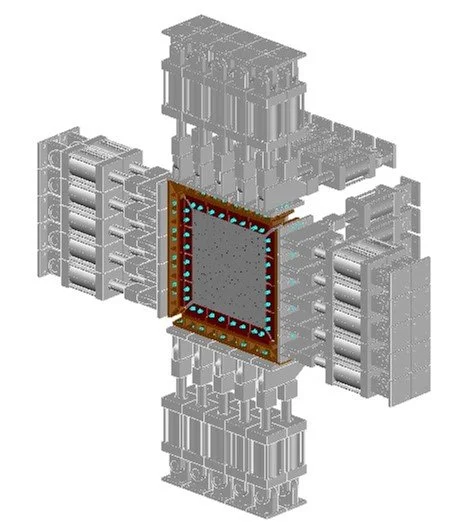
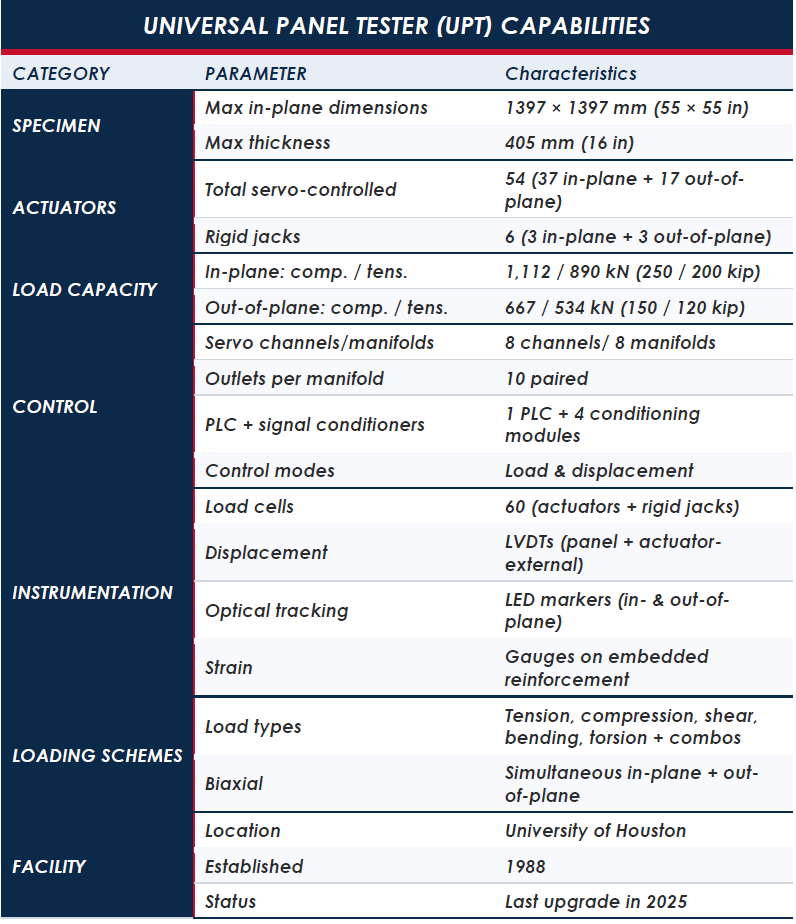
The Tester is located in the Structural Research Laboratory at University of Houston. It can perform biaxial or triaxial tests on full-size panels with a maximum edge size of 55 inches and a thickness up to 16 inches. The test panels can represent elements from large-scale structures, such as shear walls, beams, girders, shell structures, nuclear containment vessels, and concrete offshore platforms.
The jacks are controlled individually by a servo-controlled hydraulic system consisting of a 5,000-psi pump, a control board with 60 four-way valves, 0.7 km of hardline steel tubes and high-pressure hoses, and a servo-control system. The servo-control system enables panel testing in either load-control or strain-control modes and has the capability of switching from one mode to another in real time.
UPT is one-of-a-kind in terms of the stress states that it can generate in full-scale test panels. It can apply compression, tension, shear, bending, and torsion loads as well as any of their combinations. The Universal Element Tester consists of thirty-seven in-plane jacks and seventeen out-of-plane jacks. It includes three in-plane rigid links that serve as in-plane reaction supports and three out-of-plane rigid links that are used to maintain equilibrium in a three-dimensional space.
Prospective Users: The following documents provide an overview of UPT’s capabilities:
Module 1: Introduction to UPT
Module 2: Panel Preparation
Module 3: Panel Installation
Module 4: Operation
Module 5: Software
Module 7: Test Example for Pure Shear
CAD Description 1: CAD of UPT Structure
CAD Description 2: CAD of UPT Actuator System
CAD Description 3: CAD of UPT Beam-Column Test Installation
Acknowledgements: Yousef Abu Amneh (PhD Student), Abdulrahman Salah (PhD Student), Tito Gomez (DAT Consulting), Richard Reeves (Gardner Systems)
Detailed Description:
Amneh, Y. A., Salah, A., Kalliontzis, D., and Gomez, T. (2026). “Development and capabilities of the universal panel tester for large-scale testing and constitutive characterization.” Frontiers in Built Environment, Vol. 12. https://doi.org/10.3389/fbuil.2026.1862913.
Inquiries sent to: dkallion@central.uh.edu
Historical Review
The Universal Panel Tester (UPT) was established in 1988 to close a persistent gap in structural engineering research: conventional tests could not characterize full-scale structural elements under well-defined multi-axial stress states. The facility's early years produced some of the most consequential discoveries in reinforced concrete mechanics. UPT panel data underpinned the softened truss model theory for shear and torsion and enabled the derivation of the constitutive laws of tension stiffening. A 1993 closed-loop servo-control upgrade introduced displacement control and independent actuator programming, and by imposing shear at fixed crack orientations, the UPT isolated the concrete contribution to shear resistance, founding the Fixed-Angle Softened Truss Model.
Through the late 1990s and 2000s, UPT experiments built a systematic constitutive framework for cracked reinforced concrete: biaxial tests quantified compression softening, and the facility's independent biaxial control yielded the Poisson ratios, revealing that the post-cracking Poisson effect departs fundamentally from continuous elastic media. These measurements proved essential to the Softened Membrane Model and its cyclic extension, with further extensions to high-strength concrete, FRP-strengthened, and composite steel-plate systems.
The most recent chapter belongs to ultra-high-performance concrete. UHPC panel tests conducted between 2022 and 2024 resolved the material's strong sensitivity to axial stress fields, exposed the role of fiber bridging and alignment, and revealed size effects in tensile response. In 2025, a comprehensive control-system upgrade introduced per-actuator load-cell feedback, PLC-synchronized multi-actuator operation, and integrated data acquisition; commissioning tests tracked commanded loads with a median within-bank standard deviation of 1.07% of target.
Looking forward, the UPT is positioned to test beam-column connections under combined demands, evaluate wave energy converter hulls under open-ocean stress states, and anchor an incrementally synchronized digital-twin framework in which an SMM-based finite element model evolves in lockstep with the physical experiment. Nearly four decades on, the UPT continues to generate the element-level data on which the next generation of structural models depends.

Demonstration of in-plane testing with UPT
Installation of Panel in UPT